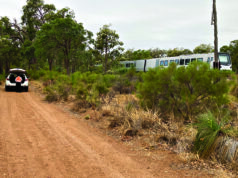


The Kitty’s Gorge trail will be closed for more than two months while non-native plantation timber is removed from the area.
The Shire of Serpentine Jarrahdale said the trail would be closed from Sunday, January 4, to Saturday, March 7.
The works will be undertaken by the Department of Biodiversity, Conservation and Attractions (DBCA), with timber harvesting managed by the Forest Products Commission (FPC).
The FPC spokesperson said contractors would haul the non-native pine by semi-trailer to wood manufacturer Wesbeam in Neerabup, about an hour and a half north of Perth.
The harvested timber will be processed into laminated veneer lumber (LVL), a structural product used in residential construction.
The FPC said the timber would support Western Australia’s housing industry.
Australian Bureau of Agricultural and Resource Economics and Sciences (ABARES) executive director Jared Greenville said timber remained a key material in the construction sector.
“Timber is a valuable resource, widely used in Australia’s construction sector,” Dr Greenville said.
“Demand for construction related timber is expected to grow by about 50 per cent by 2050 as the population increases, but the final volume will vary depending on our future preferences for housing types, with some houses using more timber than others.”
The FPC said the trees being removed were pinus radiata, a non-native softwood species planted over many decades to reduce Australia’s reliance on imported timber.
The spokesperson said the stand dates back to the 1963-64 planting period and was well beyond the commission’s typical 30 to 35-year standard rotation.
According to the FPC, drought stress had begun to appear in the ageing trees, prompting their removal on environmental and safety grounds.

“Once the pine trees have been harvested, the intention is for the area to be incorporated into the adjoining Serpentine National Park as part of the forest management plan 2024-2033, supporting the plan’s broader reservation goals,” the spokesperson said.
The timing of the trail closure was chosen to minimise disruption and safety risks.
The FPC said safety risks to the public were minimal, with the area designated as a work zone and supported by appropriate signage and site handover procedures.
The spokesperson said the January to March period coincided with the lowest visitor numbers, as summer heat significantly reduced walking and hiking activity.
“The decision was made in collaboration with the Department of Biodiversity, Conservation and Attractions (DBCA), which advises against bushwalking in hot weather conditions with high fire danger,” the spokesperson said.
While the intention is to reopen the Kitty’s Gorge trail once works are complete, a post-works safety assessment would be required before public access is restored.
DBCA said it would carry out a visitor risk assessment to confirm the area was safe and free of operational hazards.
Beyond timber recovery, the FPC said the removal of ageing, drought-stressed pine trees was expected to deliver ecological benefits.
The FPC said outcomes included reduced fire risks associated with old pine stands, improved long-term biodiversity and habitat quality as well as fewer safety and maintenance issues linked to declining plantation health.
Over time, these changes are expected to support healthier landscapes and a safer visitor experience within the park.