
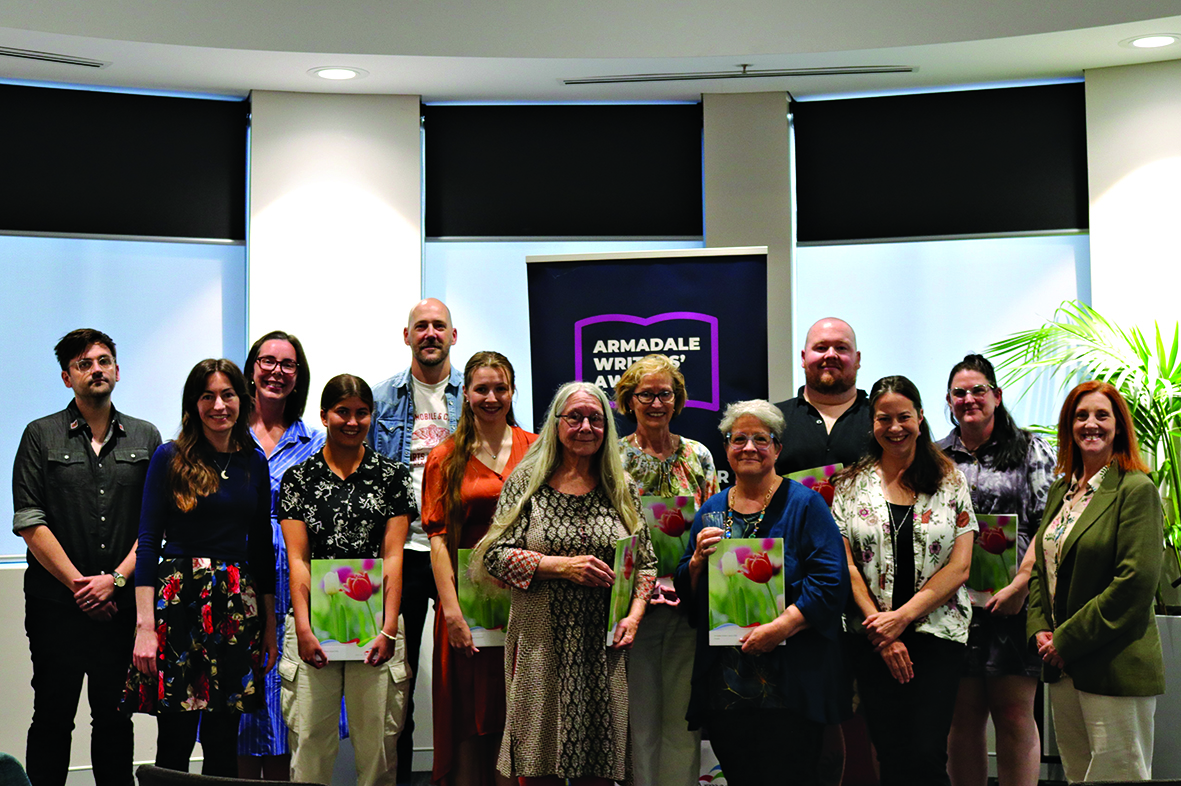
David Harris’ story about the toll of Australia’s cost-of-living crisis and Joy Kilian-Essert’s tale of isolation were the winning entries at this year’s Armadale Writers’ Award (AWA).
When Glen Forest writer David Harris sat down months ago to draft what he thought would be a simple writing exercise, he wasn’t expecting an award-winning piece, he said.
“I actually sat down just to write a scene rather than a story,” Harris said.
“It was a writing exercise; stripping as much excess information out of the narrative as I could, keeping it simple, but still having emotional resonance.”
Harris said the short piece sat untouched for months until he revisited it and realised it had taken a life of its own.
“I got to the end of the passage and was happy with it,” he said.
“The ending made it feel resolved rather than a scene. It felt like something that could stand on its own.
“So, I decided to submit it.”
His winning story centres on two characters in conversation.
“I let the characters tell the story for me,” he said.
“It speaks to social situations that exist in Australia at the moment. A lot of people are struggling through the housing crisis.
“It gave me an opportunity to examine that from a couple of different points of view.”
Harris said he gravitates towards literary realism, particularly contemporary stories grounded in Australian settings.
More than a decade ago, Harris was accepted into the Australian Society of Authors’ emerging mentorship program and last year, became part of the Writing WA’s emerging writers’ program.
He’s also won several short story competitions, including the Best Australian Yarn.
“I’ve always read widely. It fascinated me from a young age,” he said.

“Life has led me down many paths, and about 10 years ago I decided to commit to writing.”
Taking out second place was author Joy Kilian-Essert, a storyteller who once stapled her own books together as a child and never stopped writing.
“I’ve been scribbling stories since I was a child,” she said.

“After a creative writing degree at Curtin and years of daily practice, it’s become an essential part of who I am.”
Kilian-Essert said short stories were her preferred form.
“For a small package they pack a powerful punch, and require discipline to do well,” she said.
“I don’t claim to get it right all the time, but when I do, regardless of the subject matter, the magic takes over.”
She said her awarded piece was inspired by a book on Appalachian folklore, particularly the way farming traditions intersected with spiritual and supernatural beliefs.
“I really wanted to include an element of the extraordinary into what is otherwise a simple tale of loneliness,” she said.
Kilian-Essert said she became invested with the story’s central character, Tree Man.
“I felt very strongly for Tree Man; his loneliness, isolation and difficulty relating to others made me want to provide him with something of a happy-ever-after,” she said.
At its core, Kilian-Essert said her story was about humanity.
“We all feel lonely or frustrated from time to time,” she said.
“If a story can remind a reader that simple connection is possible, that might be a good thing. And perhaps there’s more than a bit of Tree Man in all of us – especially me.”
Kilian-Essert said she doesn’t enter competitions like AWA with the expectation to win.
She said it’s simply fun to enter and also a good incentive to finish a piece.
“I’m grateful writers have opportunities like this,” she said.
“I’ve entered the Armadale Writer’s Award before with no success, so to make second place this year is a surprise and a delight.”
For Harris, the Armadale Writers’ Award provides an accessible platform for both new or existing writers.
“It’s a great opportunity to have something like that in our backyard to get involved in,” he said.