
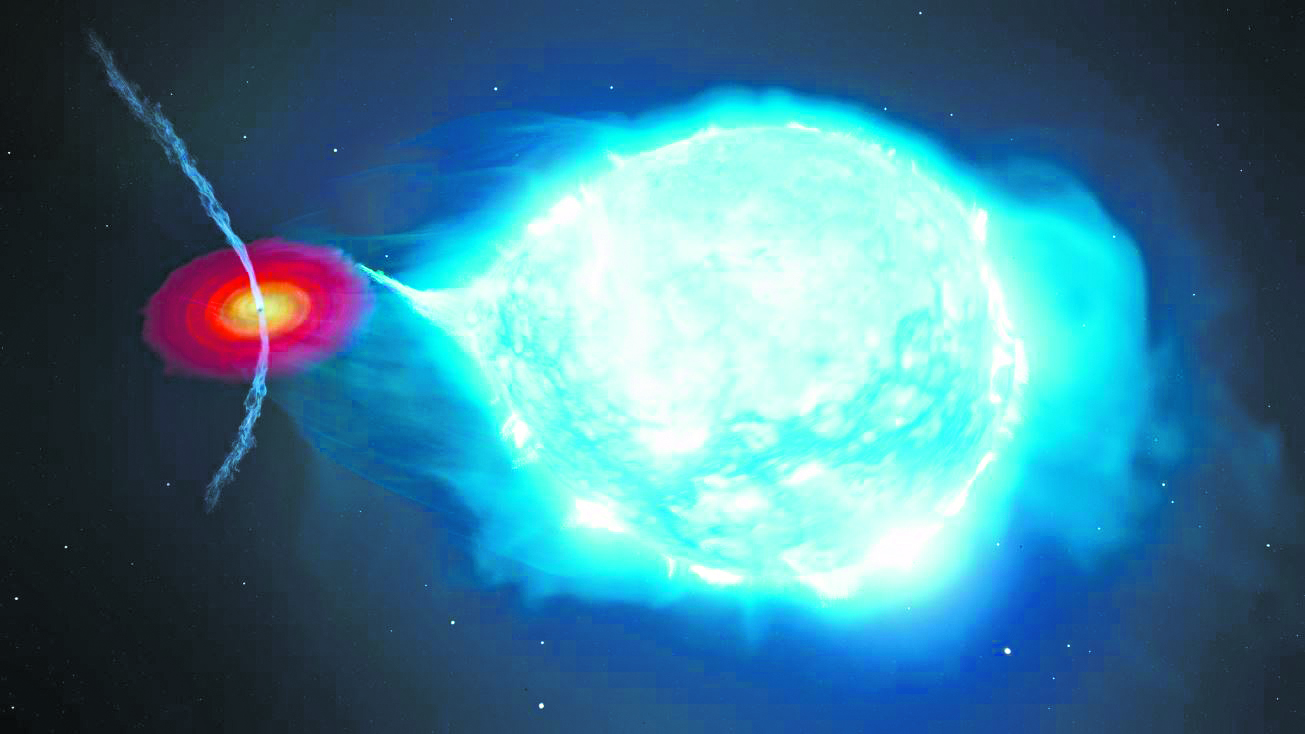
Jets blasting from a black hole have been seen shifting in space like a slow waltz, giving scientists a new way to measure their power.
The movement, described as “dancing jets”, was captured in a Curtin University-led study of Cygnus X-1, the first black hole system ever confirmed.
One of the researchers, Professor James Miller-Jones said the unusual motion came from a clash between two powerful forces.
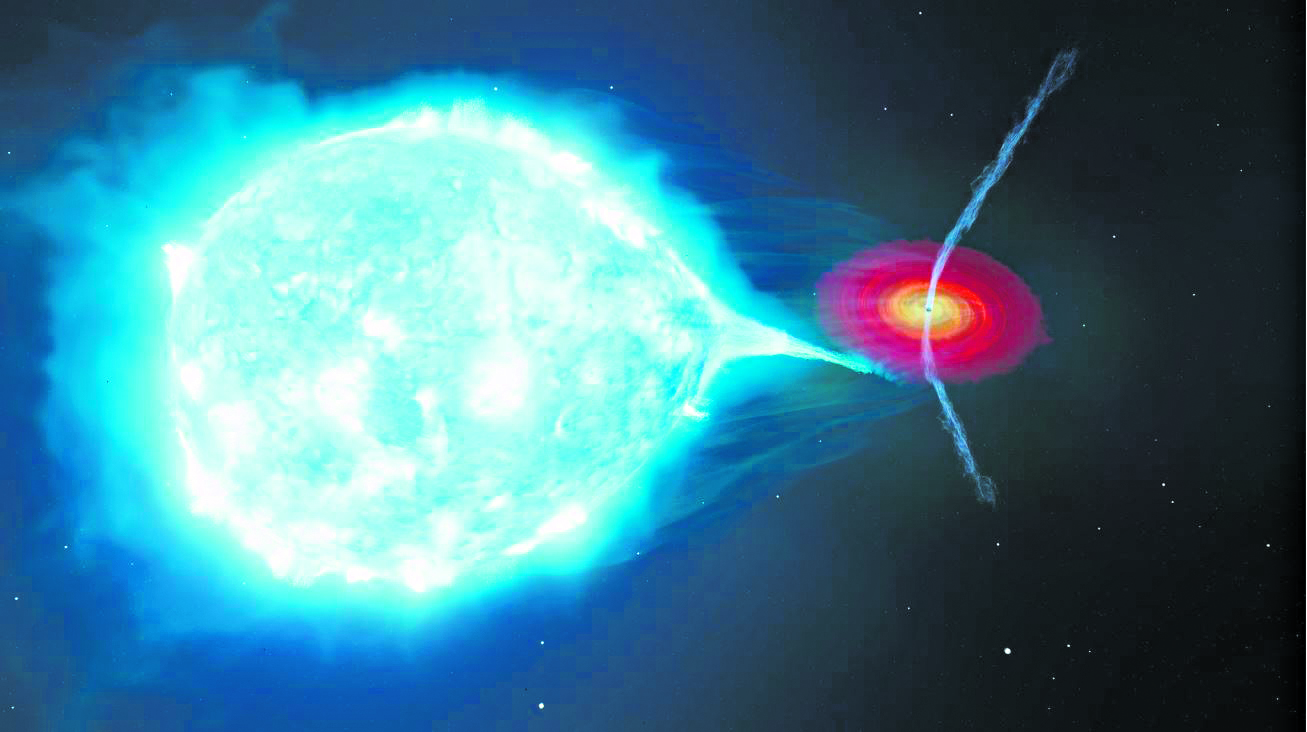
The black hole, locked in orbit with a massive star, fires out jets of material at speeds close to light. At the same time, the star releases an intense wind that pushes back against those jets.
“We saw that the jets were being bent away from the star, no matter which side of the black hole was on,” he said.
“That tells us that the wind from the star was pushing against the jets and bending them.”
That bending turned out to be the key.
By measuring how much the jets were deflected and comparing it to the known strength of the star’s wind, the team was able to calculate the jets’ power at a given moment; something scientists have struggled to do.
“So, we want to know how much energy that they’re carrying away and dumping into the environment, but that’s been challenging to do, because most of the energy they carry, it’s the energy of the moving material, rather than radiation. So, we don’t see it,” Professor Miller-Jones said.
The study found the jets produce energy equivalent to about 10,000 Suns and travel at roughly half the speed of light.
From Earth, the interaction creates the appearance of motion, with the jets shifting direction every few days as the black hole and star circle each other about every 5.6 days.

“We use that term to describe the way that the jets were moving around… they appeared to move every few days… like a waltz,” he said.
Cygnus X-1 has been drawing in material from its companion star for about 20,000 years. Some of that matter falls into the black hole, while some is redirected outward in jets that can extend up to about 16 light years.
Understanding how much energy goes into those jets helps scientists work out how black holes grow and how they affect their surroundings.
“That allows us to compare how much power comes out of the jets with the amount of energy that’s available from the material that’s falling into the black hole,” Professor Miller-Jones said.
The research was led from Curtin University, with collaboration from international partners including the University of Oxford.
Lead author Steve Prabu worked at Curtin during the study and is now based at Oxford.
Although the system was observed using telescopes across North America, the findings are expected to support future work closer to home, including the Square Kilometre Array project being built in Western Australia.
The study has been published in ‘Nature Astronomy’.