
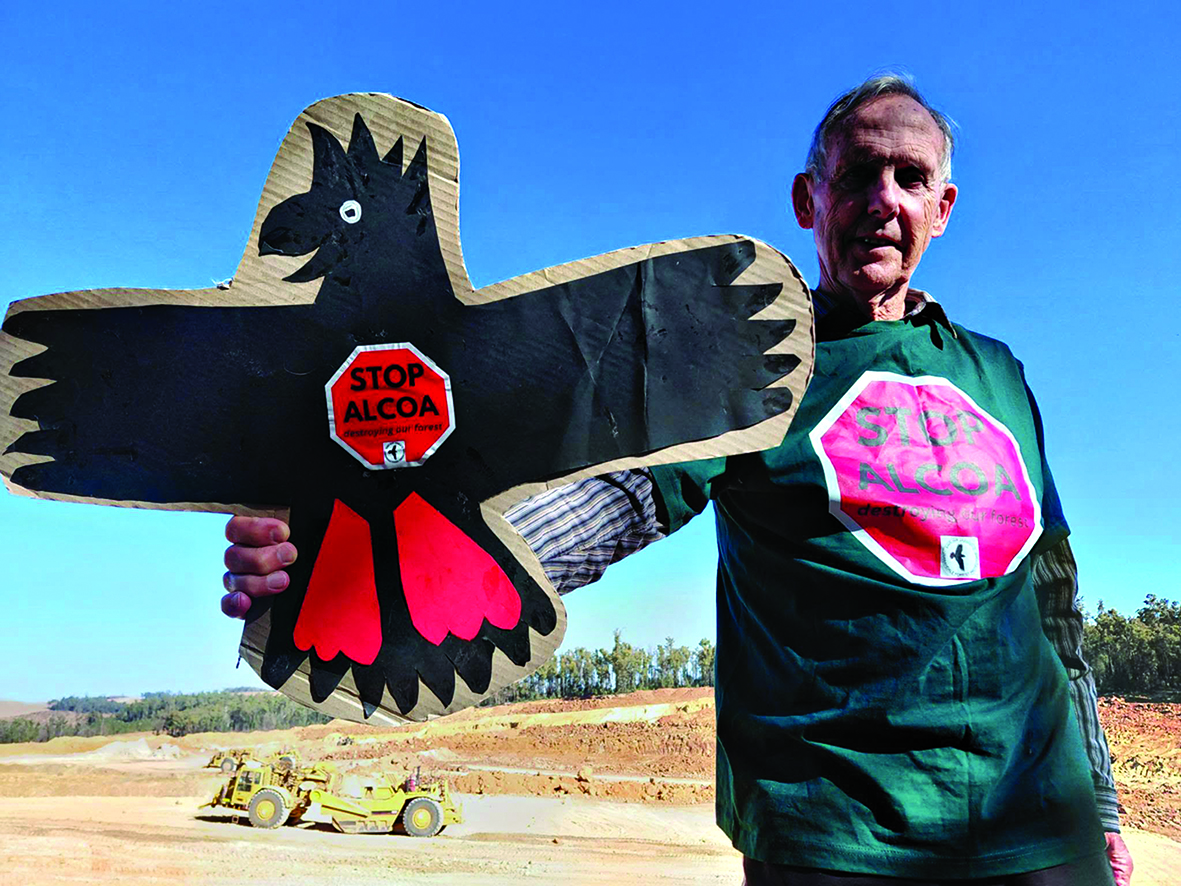
Well-known former politician and environmentalist, and pioneer of the early parliamentary Greens party, Bob Brown, joined campaigners from Jarrahdale Forest Protectors in Western Australia’s Northern Jarrah Forest to protest what the group describes as the escalating destruction caused by Alcoa’s bauxite mining operations.
Mr Brown first came to the attention of the Australian public following his election to the Senate on the Tasmanian Greens ticket, after which he joined sitting Greens Western Australia senator Dee Margetts to form the first group of Australian Greens senators following the 1996 federal election. He was re-elected in 2001 and 2007 and ultimately resigned in 2012.
During his service in the Tasmanian parliament, Brown campaigned for a large increase in the protected wilderness areas of the state. Mr Brown led the Australian Greens from the party’s foundation in 1992 until April 2012, a period that saw polls grow to around 10 per cent at state and federal levels.
The former senator’s visit comes amid what the Jarrahdale Forest Protectors claim is: “growing public outrage following revelations that Alcoa unlawfully cleared thousands of hectares of native forest habitat between 2019 and 2025 without required federal approvals.
Further, the group stated: “The company was recently forced into a $55 million enforceable undertaking after the Federal Government confirmed the clearing impacted habitat for nationally protected species, including endangered black cockatoos.
“Bob Brown met with us enroute to multiple speaking engagements here in WA. Time was short, so we spoke over lunch and then drove to a nearby location to show him the impacts of Alcoa’s bauxite mining on the Northern Jarrah Forest. We parked and walked a short way and before we could blink, Bob was standing atop the embankment on the edge of the mining area.
Mr Brown promptly said the Northern Jarrah Forest is: “one of the great forests of the world” and warned that continued mining threatens irreplaceable biodiversity, water catchments, and climate stability.
“Alcoa are brutes. The politicians are weak as water. It is up to us the people to put an end to this sort of needless destruction. This is what is called a disaster zone for anywhere on the planet.
Jarrahdale Forest Protectors say today’s visit highlights the growing national concern over the ongoing industrialisation of WA’s native forests despite what they view as mounting scientific warnings and widespread community opposition.
“People are shocked when they see the scale of destruction with their own eyes,” Merri Harris, Chair for Jarrahdale Forest Protectors, said.
“These forests cannot simply be bulldozed and recreated. Once the ancient jarrah ecosystem and bauxite-rich geology are destroyed, they are gone forever.”
The group has repeatedly criticised both State and Federal governments for allowing Alcoa to continue operating while broader environmental assessments are underway. Several environmental organisations have criticised the decision to grant the mining giant ongoing exemptions to proceed with clearing.
The Northern Jarrah Forest has long been recognised as one of the world’s most biodiverse temperate forests and provides critical habitat for species including Carnaby’s black cockatoo, Baudin’s black cockatoo, Forest Red Tail cockatoo, quokkas, woylies and chuditch. The forest also protects major drinking water catchments supplying Perth and surrounding communities.
Alcoa WA responded to Mr Brown’s claims.

“Alcoa Australia acknowledges that land clearing can be confronting, and community concerns, particularly in sensitive areas like WA forests, are understandable. At the same time, the world needs the aluminium produced by mining bauxite to meet rising demand for renewable energy infrastructure and decarbonisation, and for an extensive range of everyday products, from kitchen appliances and electronics to lifesaving medical equipment,” an Alcoa spokesperson said.
The mining giant has emphasised its strong involvement in, and support for, local affairs and events, as well as the employment opportunities it provides to the people of Serpentine Jarrahdale and beyond.
“We directly employ about 4,000 people in WA and deliver substantial indirect benefits to many thousands more through local business support, community spending, education, and regional development. Many members of our workforce live locally and have built their careers with Alcoa while contributing to their communities as leaders, volunteers, and through local spending.
“These members of our workforce are also active users of the environment for recreation and other purposes, meaning these individuals have direct stakes in economic, social, and environmental values.
“Australia’s robust environmental controls are designed to minimise impacts on land, water, and biodiversity. That is why we only mine areas that have been previously disturbed by logging, avoid old growth forest and areas of high conservation value, and have implemented extensive no-mining zones to protect areas of significant social, recreational and environmental value.”
The company has further emphasised its extensive work on forest rehabilitation, claiming to have revegetated the majority of the land it has cleared.
“Today, about 80 percent of areas cleared for mining are under various stages of rehabilitation, and research and evidence show our efforts are supporting desired outcomes. In 2025, we commenced rehabilitation work on more than three times the area that was cleared for mining.
“We maintain that no areas have been cleared unlawfully, as we have worked within a longstanding approval framework, and we are working with the state and federal governments to modernise the approvals process.
“The claim that jarrah forest cannot be returned after bauxite has been removed is not supported by valid science or the evidence we see in the areas where we have undertaken rehabilitation work. While those areas are at different stages of development, we first trialled the return of entirely native jarrah forest species in the mid-1970s in an area that today shows a broad range of ecosystem functions that have returned.
“Many of the methods developed during that trial have been refined and are used today to ensure areas where rehabilitation work is carried out are set on a trajectory to becoming healthy, self-sustaining jarrah forest over time.”